

In the chemical industry, particularly in the manufacturing of detergents and cleaners, “Layered Sodium Silicate” and “Layered Complex Sodium Silicate” are two terms that are often encountered. While they share a common base material and are both used as detergent builders, they are fundamentally different in terms of chemical definition, production process, and application performance.
To understand the distinction, it is helpful to view Layered Sodium Silicate as a single, pure active ingredient, whereas Layered Complex Sodium Silicate is a formulated product designed for specific industrial applications.
1. Definition and Chemical Structure
Layered Sodium Silicate (Pure):
This refers to a specific chemical compound with a defined crystalline structure. Its chemical formula is typically represented as δ-Na₂Si₂O₅ (delta-phase sodium disilicate). The term “layered” refers to its unique crystal lattice, where SiO₄ tetrahedra form two-dimensional sheets, with sodium ions residing in the interlayer spaces. This specific structure is obtained through a controlled thermal process that transforms amorphous (glassy) sodium silicate into a highly ordered crystalline state. It is a single-phase material with a specific X-ray diffraction pattern and a defined molar ratio (SiO₂/Na₂O ≈ 2).
Layered Complex Sodium Silicate:
This is not a single chemical compound but a composite material or a formulated product. It is manufactured by using pure Layered Sodium Silicate as the base framework and then combining (compounding) it with other inorganic or organic components. Common additives include sodium carbonate (soda ash), sodium sulfate, surfactants, or polymers. The goal of this complexation is to enhance certain properties. Therefore, a “complex” product lacks a single, universal molecular formula and is instead defined by its performance specifications and the specific ratios of its components.
2. Manufacturing Process
Layered Sodium Silicate Production:
The core of its production is crystallization. The process begins with amorphous sodium silicate glass (often produced in a furnace). This glass is then subjected to a precise heat treatment in a kiln at temperatures ranging from 600°C to 800°C. This annealing process rearranges the disordered molecular structure into the desired crystalline layered phase (such as the highly effective delta phase). Strict control of temperature and residence time is critical to ensure the formation of the correct crystal phase with maximum ion-exchange capacity.
Layered Complex Sodium Silicate Production:
The production emphasizes mixing and formulation. The complex product can be made in several ways:
1. Physical Mixing: Dry blending of pure layered silicate powder with other powdered additives.
2. Co-Granulation: Combining the layered silicate with additives in a wet process followed by granulation or spray drying to create homogeneous particles. This method, such as using high-tower spray drying, is often used to create hollow, spherical beads that improve the flowability of detergent powders.
The focus here is on creating a product with optimal physical properties (particle size, solubility) and a balanced chemical functionality for a specific use.
3. Performance Characteristics
The structural and compositional differences lead to distinct performance profiles:
Feature 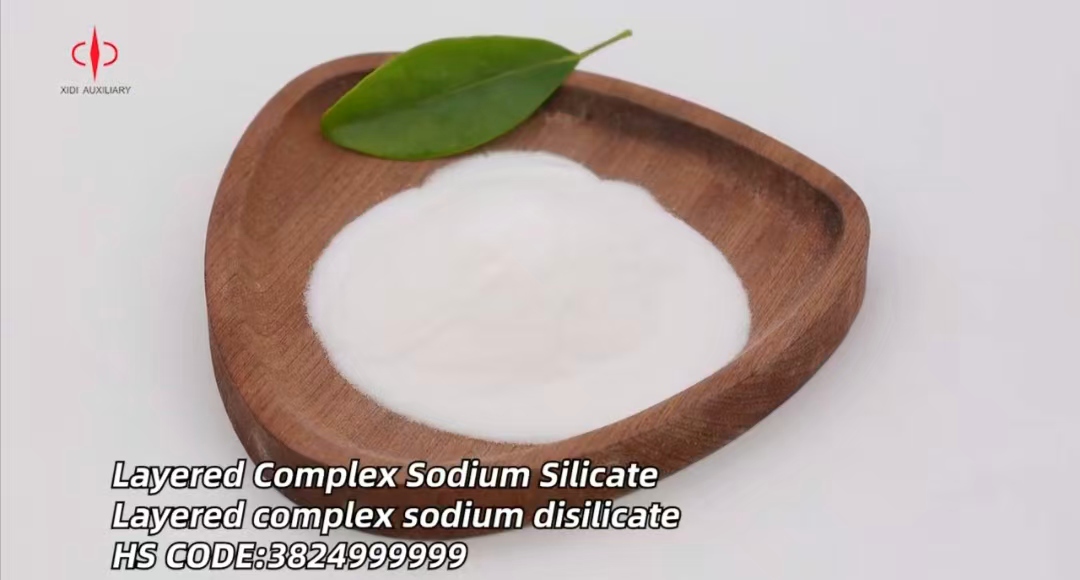 Layered Sodium Silicate (Pure) Layered Complex Sodium Silicate
Primary Mechanism Ion Exchange: The layered structure Synergistic Effect: While retaining
selectively traps calcium (Ca²⁺) and ion-exchange capability, the added
magnesium (Mg²⁺) ions from hard components contribute other
water, exchanging them for sodium functions. For example, carbonate
ions. This softens the water efficiently. provides strong alkalinity for
saponifying greases, and polymers
help prevent soil redeposition.
Calcium Binding High and standardized. National Variable, depending on the formula.
Capacity standards (e.g., GB/T 20214-2006) The stated capacity might be silmilar
often require a calcium exchange or slightly higher, but it results from
capacity of ≥300 mg CaCO₃/g. the combined action of all components,
not just the layered structure.
Solubility & Alkalinity Provides a high pH but acts primarily Engineered for “rapid dissolution”
as a water softener. Its dissolution is and often provides a stronger and
based on layer expansion and exfoliation. more sustained pH buffer
throughout the wash cycle due to
the presence of alkaline salts.
Physical Properties High purity, with total active matter Lower total active matter content
(Na₂O+SiO₂) often >95%. (e.g., >75-80%) but optimized for
industrial handling, such as improved
powder flow and resistance to caking.
4. Application in Industry
• Layered Sodium Silicate: Its primary and most critical function is as a high-performance buildersubstitute for Sodium Tripolyphosphate (STPP) in phosphate-free laundry powders. Its main job is water softening. It is chosen when maximum ion-exchange capacity is required in a formulation.
• Layered Complex Sodium Silicate: This is designed as a multi-functional additive. It serves not only as a builder but also as:
◦ A Processing Aid: It improves the rheology (flow properties) of detergent slurries, making them easier to handle during spray-drying.
◦ A Carrier: Its porous structure allows it to absorb liquid ingredients (like non-ionic surfactants), simplifying the manufacturing process.
◦ A Comprehensive Performance Booster: It contributes to overall detergency, including stain removal from fabrics and protection against corrosion of washing machine parts.
Conclusion
In essence, Layered Sodium Silicate is a pure, high-purity raw material with a specific chemical structure and a focused function. In contrast, Layered Complex Sodium Silicate is an engineered formulation that uses the layered silicate as a core component. It is tailored to meet the complex demands of modern detergent manufacturing, offering not just water softening, but also improved production efficiency and broader cleaning power. Choosing between them depends on whether the goal is to source a specific chemical builder or to utilize a ready-to-use, multi-functional additive.
Post time: Mar-03-2026